
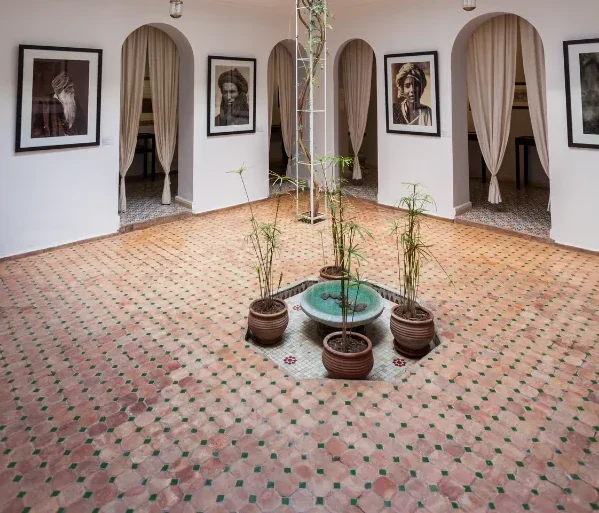
Situés au cœur de la médina historique, le musée de Marrakech et Dar el Bacha – Musée des Confluences sont deux des sites culturels les plus remarquables de la ville. Ces destinations offrent une exploration enrichissante de l’identité marocaine, où l’architecture, l’art, l’artisanat et le patrimoine se côtoient dans des palais magnifiquement préservés.
La visite de ces deux sites permet de mieux comprendre l’héritage intellectuel et artistique de Marrakech, ce qui en fait des étapes incontournables pour les amateurs de culture, les passionnés d’histoire et les voyageurs à la recherche d’expériences marocaines authentiques.
Musée de Marrakech (Musée de Marrakech)
Un palais historique mettant en valeur l’art et l’artisanat marocains.
Installé dans le magnifique palais Dar Menebhi, le musée de Marrakech est célèbre pour sa splendeur architecturale et ses collections culturelles variées. Construit à la fin du XIXe siècle par Mehdi Menebhi, le palais illustre les plus belles traditions du design andalou et mauresque.
Points forts architecturaux
Un lustre central qui domine la cour avec une élégance spectaculaire
Cette composition architecturale à elle seule vaut le détour.
Collections et expositions
Le musée présente un mélange éclectique :
Le musée sert de pont entre le passé et le présent, offrant une perspective globale de l’évolution artistique marocaine.
Ambiance et expérience
Un chef-d’œuvre de l’architecture palatiale marocaine et du dialogue culturel
Construit en 1910 pour servir de résidence au pacha Thami El Glaoui, Dar el Bacha est l’un des palais les plus magnifiquement restaurés de Marrakech. Il abrite aujourd’hui le Musée des Confluences, un musée culturel dédié à la mise en valeur des diverses influences (arabes, amazighes, juives, andalouses, africaines et orientales) qui ont façonné la civilisation marocaine.
Beauté architecturale
Dar el Bacha est réputé pour son savoir-faire exceptionnel :
La restauration préserve la splendeur originale du palais, ce qui en fait l’un des monuments les plus impressionnants de la ville.
Expositions du musée
Les expositions thématiques du musée explorent :
L’accent mis sur les « confluences » souligne la position du Maroc en tant que carrefour des civilisations.
L’emblématique café Bacha
L’un des points forts de la visite de Dar el Bacha est le légendaire café Bacha, connu pour :
Il est devenu l’un des cafés les plus photographiés de Marrakech.
Les deux musées se trouvent dans la médina, à proximité :
Durée recommandée de la visite
Meilleur moment pour visiter