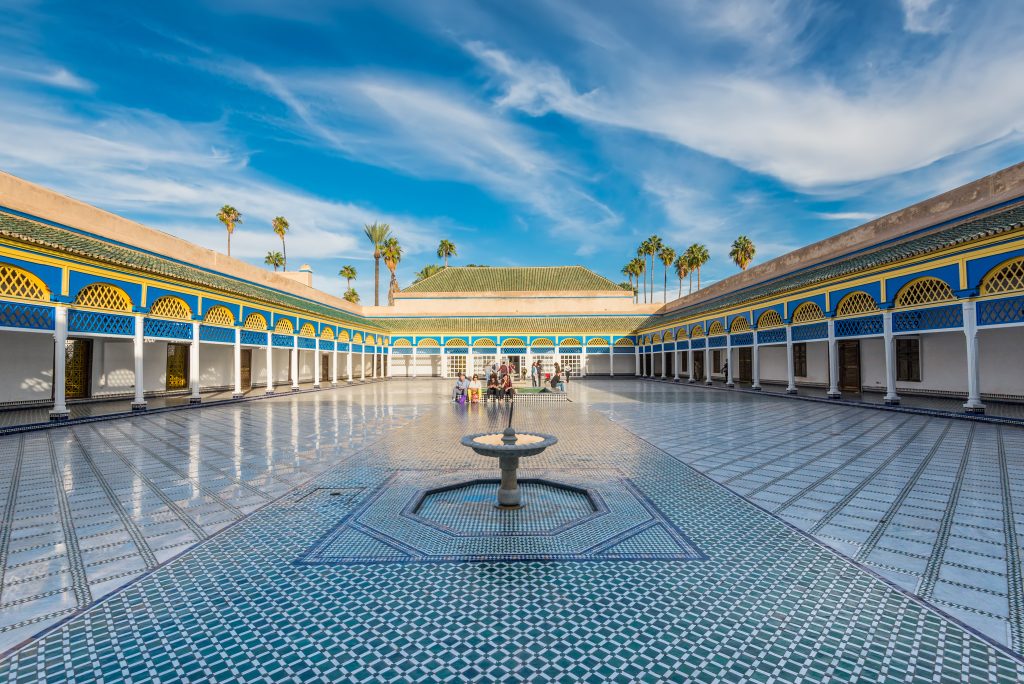
Le palais Bahia est l’un des monuments les plus précieux de Marrakech, célèbre pour son artisanat raffiné, ses cours sereines et son architecture marocaine-andalouse à couper le souffle. Construit à la fin du XIXe siècle, le palais a été conçu pour être la résidence la plus somptueuse de son époque, expression du pouvoir, du prestige et d’un art raffiné.
Contexte historique
Construit sous la direction du grand vizir Si Moussa, puis agrandi par son fils Ba Ahmed, le palais Bahia est un symbole de l’influence politique et du raffinement architectural de l’époque royale au Maroc.
- Construit entre 1860 et 1900
- Initialement destiné à servir de résidence aux dignitaires, aux invités royaux et à la famille du vizir
- Le nom « Bahia » signifie « le brillant » ou « le beau », reflétant l’ambition du palais
Le complexe du palais a été conçu pour capturer l’essence du luxe marocain : harmonieux, complexe et profondément évocateur.
Points forts architecturaux
Le Bahia Palace est réputé pour sa splendide combinaison d’art traditionnel marocain et d’esthétique andalouse.
Caractéristiques principales :
- Carrelage en zellige – mosaïques géométriques colorées qui décorent les sols et les murs avec précision.
- Plafonds en bois de cèdre sculpté – motifs peints à la main et treillis complexes témoignant d’un savoir-faire artisanal exceptionnel.
- Ornements en stuc et en plâtre – motifs floraux, calligraphies et arabesques qui embellissent les arcades et les encadrements de portes.
- Grande cour (Cour d’Honneur) – vaste cour en marbre entourée d’élégantes chambres de style riad.
- Quartiers luxueux du harem – chambres privées à la décoration raffinée, alcôves tranquilles et vue sur des jardins intimes.
Chaque espace est conçu pour évoquer la beauté, la sérénité et la grandeur. Chaque porte révèle une nouvelle perspective et une surprise architecturale.
Les jardins et les cours
Le palais est niché au cœur de jardins luxuriants, typiques de l’Andalousie et du Maroc.
- Les orangers, les jasmins et les cyprès embaument l’air de leurs parfums.
- Des allées ombragées mènent à des cours cachées et à des coins salon paisibles.
- Les fontaines centrales apportent une touche apaisante à l’atmosphère du palais.
Les jardins créent un contraste paisible avec l’énergie vibrante des rues de Marrakech, faisant du palais Bahia une oasis de tranquillité.
Importance culturelle
Le palais Bahia capture l’essence de la vie à la cour marocaine à la fin du XIXe siècle.
- Il reflète la hiérarchie sociale de la maison du vizir, y compris ses épouses, ses enfants et son personnel.
- Le palais accueillait des banquets royaux, des conseils politiques et des réceptions diplomatiques.
- Il reste un élément essentiel du patrimoine culturel et de l’identité architecturale du Maroc.
Aujourd’hui, le palais Bahia est considéré comme l’un des sites historiques les mieux préservés de Marrakech et un lieu incontournable pour tous ceux qui s’intéressent à l’art, à l’histoire et au design.
L’expérience des visiteurs
Les voyageurs sont invités à flâner à leur guise dans les salles communicantes, les grandes salles et les jardins exotiques.
À quoi s’attendre :
- Un environnement calme et atmosphérique malgré sa popularité.
- Une belle lumière naturelle qui met en valeur les textures et les couleurs du palais.
- D’innombrables occasions de prendre des photos, en particulier dans la grande cour et les salles en bois de cèdre.
- Un aperçu de l’artisanat, de l’architecture et des traditions aristocratiques marocaines.
Prévoyez au moins 45 à 60 minutes pour explorer l’ensemble du complexe.
Emplacement et accessibilité
Le Bahia Palace est situé dans le sud de la médina, à proximité de plusieurs attractions majeures :
- Palais El Badi – 7 minutes à pied
- Jemaa el-Fnaa – 10 minutes à pied
- Mellah (quartier juif) – 5 minutes à pied
- Tombeaux saadiens – 12 minutes à pied
Le quartier est agréable pour les piétons et facilement accessible en taxi ou à pied.
Conseils aux visiteurs
- Arrivez tôt le matin pour éviter la foule et profiter d’un cadre paisible pour prendre des photos.
- Habillez-vous de manière décente, car il s’agit d’une résidence royale historique.
- Apportez de l’eau, en particulier pendant les mois chauds.
- Des visites guidées sont proposées et permettent de mieux comprendre l’histoire et l’architecture du palais.